 Historical Accountability Student Research Program
The Early Record
In October 1903 the Dartmouth football team travelled to Princeton and could not all stay in the same hotel. Matthew W. Bullock, Class of 1904, was Dartmouth's first Black varsity football player, and the Princeton Inn refused to give him a room. His teammates declined to stay without him. The team slept in New York and made the trip down on the morning of the game.
On the first play from scrimmage, Princeton players piled on Bullock and broke his collarbone. He never played again. One afternoon ended both his season and his college playing career.
It would be easy to file this as an away-game indignity from a rougher era and leave the blame in New Jersey. This exhibit starts instead with a question: was Bullock's experience an anomaly, or a pattern that Dartmouth itself belonged to?
Ernest Martin Hopkins, Class of 1901, became the College's eleventh president in 1916 and held the office for twenty-nine years, the second-longest tenure in Dartmouth's history. In November 1920 two Dartmouth alumni in Dallas wrote to him two days apart, both asking the College to stop playing Black students on its teams. W. A. Green, Jr. wrote on the eleventh, E. W. K. Willson on the thirteenth.
To Green he wrote that the question was not one of using the athletic ability of Black students who happened to be enrolled, but of what Dartmouth's traditional attitude should mean under modern conditions. Then he set out where the College stood among its peers.
There are three attitudes among northern colleges which may be taken, one being that of Princeton, in which the color line is drawn with the utmost rigidity and the man is not even given access to the curriculum, even if he can pass all of the examinations and even though every other conceivable color or race is granted admission upon the presentation of the proper credentials. This is, of course, a straight result of the fact that Princeton has always made an appeal to and won a considerable number from the south. The second attitude is that of Yale, which gives colored men admission but where it is definitely understood that the man shall be denied all privileges of membership in the college except that of attending classes and receiving a diploma. The third attitude is that of Harvard, Dartmouth, Brown, Cornell, and Pennsylvania, where the number of negroes who can qualify for admission to the college is an insignificant number of the total enrollment, and where the man who is enough an exception to the general standards of his race so that he can qualify for college membership and then qualify in the stiff competition for membership on the athletic teams is neither given less nor more consideration than he would have under other circumstances.
Ernest Martin Hopkins to W. A. Green, Jr., 2 December 1920
As shown in the response above, the attitude Hopkins had no patience with was Yale's and Princeton's exclusion, saying that this was not the attitude of Dartmouth College.
He then handed the question over to the Trustees; however, a follow-up could not be found in the archives.
From the Archives
Click on an image to access the full document, audio-visual components, and/or metadata associated with that item.

Matthew W. Bullock was the first Black varsity football player at Dartmouth.
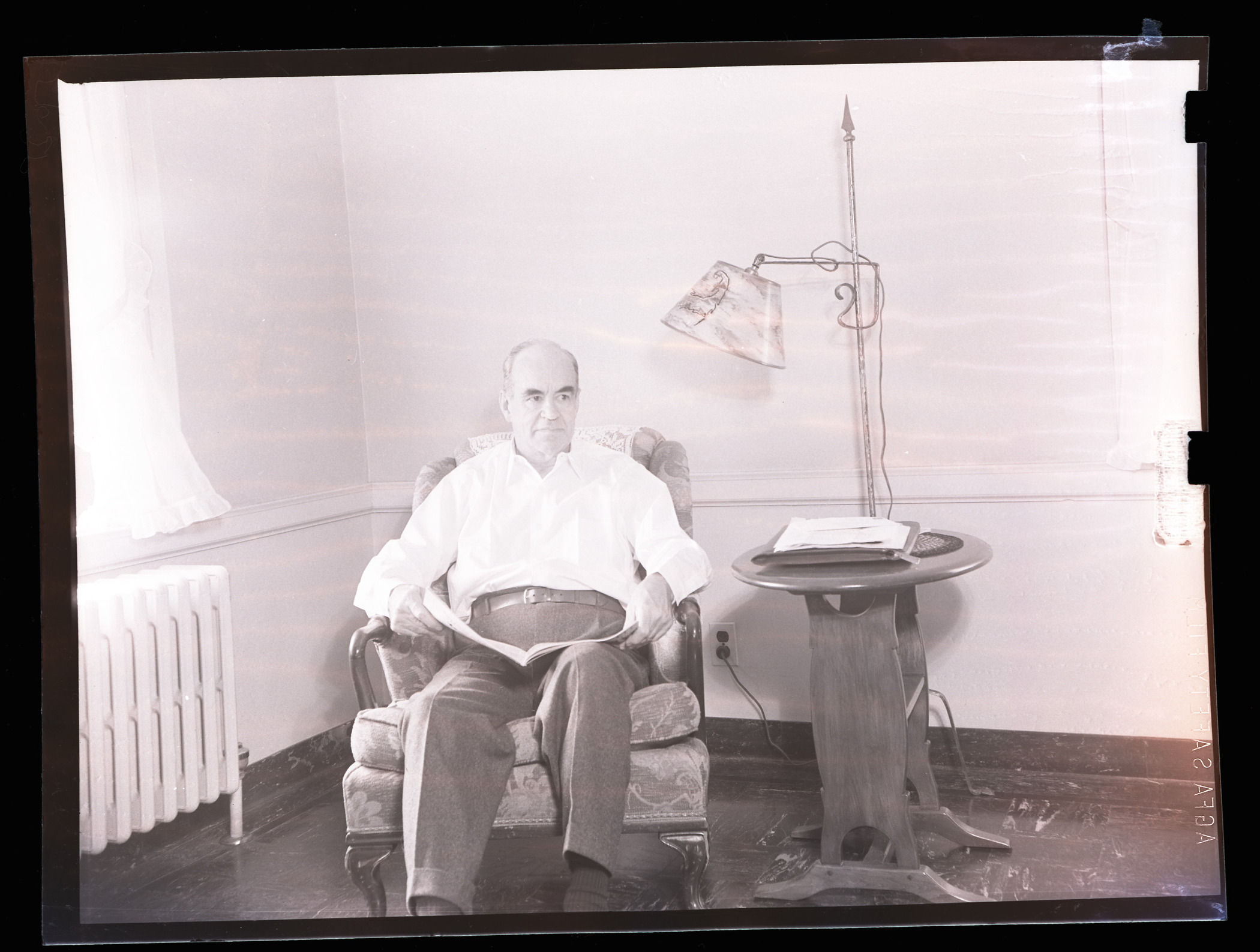
Ernest Martin Hopkins, Class of 1901, became Dartmouth's eleventh president in 1916 and held the office for twenty-nine years, the second-longest tenure in the College's history.

Hopkins replies to W. A. Green, Jr., of Dallas, who had written on 11 November 1920 about the advisability of playing negroes on the teams.
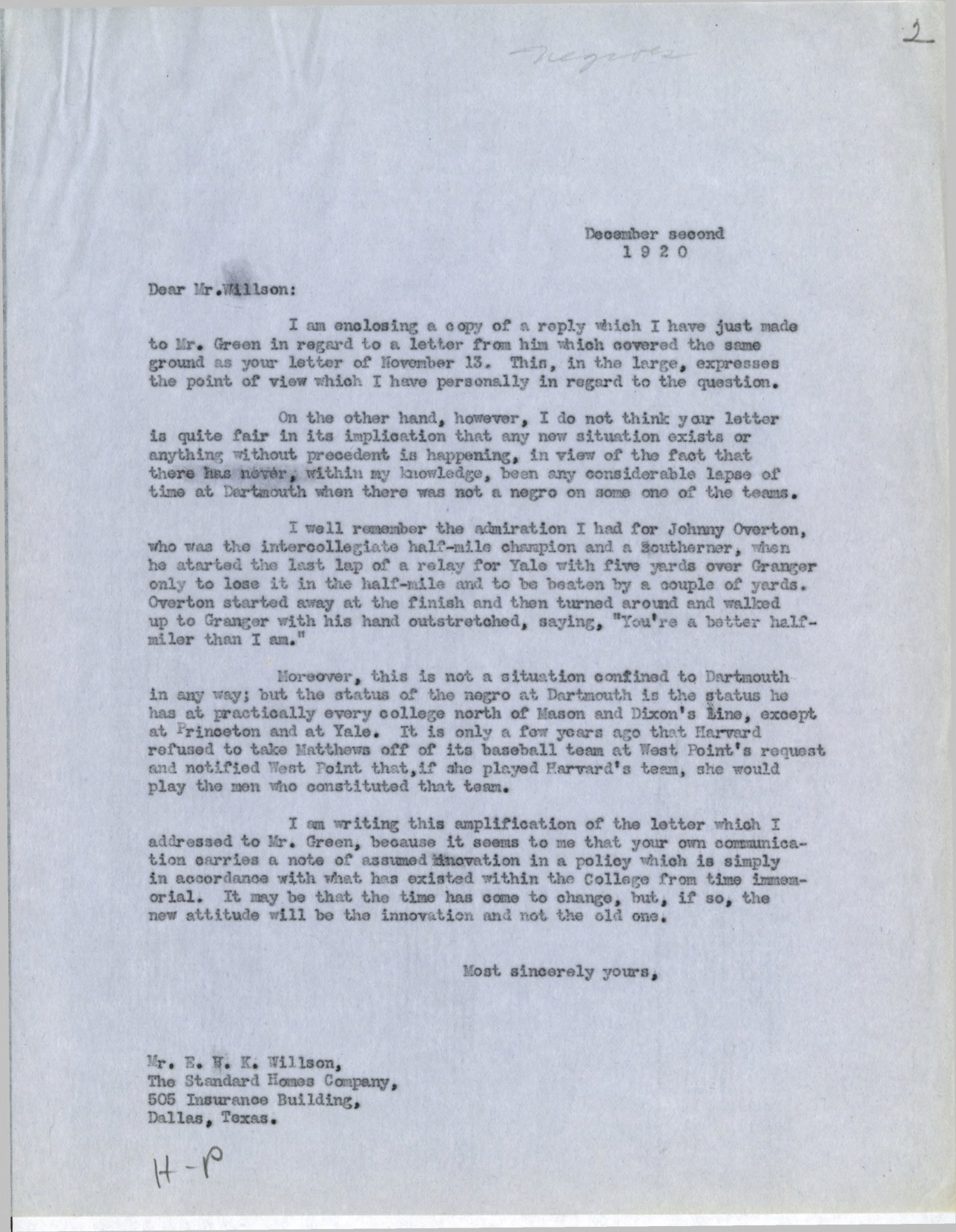
Written the same day as the reply to Green and enclosing a copy of it.

Hopkins transmits the question of Black students' athletic eligibility to the Athletic Council through J. P. Richardson, chairman of its faculty committee, rather than to the Council's president, because any action would have so many ramifications.