 Historical Accountability Student Research Program
Repealing The 18th Amendment: The Resurgence of Drinking

Front Page of The Dartmouth, March 20th 1930
Following multiple polls and student debates on campus, Dartmouth was officially "going wet" as some put it.
By the late 1920s, cracks in Prohibition were showing not only in Dartmouth but across the country. Access to alcohol had never been a serious obstacle for students, but by this point many were openly questioning the logic of the law's existence. In the early 1930s, The Dartmouth published a student poll revealing strong support for repeal, and newspaper clippings from the era show how deeply drinking was being re-woven into daily life. One particular paper pokes fun at the story of Chester A. B. , a student arrested for drunk driving but who also happened to be president of the Dartmouth League for Prohibition and a member of Student Council.
"The indispensable first step towards repeal has been taken."
Statement with Regard to Congressional Action on Repeal, made by President Ernest Martin Hopkins to The Dartmouth (February 22, 1933)
Hopkins’s correspondence from these years also reflects a shift in his personal attitude. In the early 1920s, he had treated alcohol as primarily a matter of enforcement, calling on outside authorities to help the College maintain order. By the late 1920s and early 1930s, his letters suggest growing frustrations with the law as a whole. He increasingly framed Prohibition not just as an administrative headache but as a constitutional failure deterimental to the structure of legal integrity in America. Exchanges with friends and notes to his secretary show him struggling to reconcile his personal belief in temperance with the reality of widespread noncompliance.

News Clipping of Drunken Student Arrest
Of unclear origin, this small news clipping was nested in the middle of Hopkins's letters about enforcement of Prohibition.
As the repeal movement gained traction nationally, culminating in the ratification of the 21st Amendment in December 1933, Hopkins began receiving letters from both supporters and opponents of repeal. Unfortunately for those who supported the 18th Amendment, the requests for him to endorse anti-repeal efforts often went unanswered while those in support of repeal were, more often than not, awarded with Hopkins's attention. In later public statements, he expressed relief that beer and wine were once again legal, preferring that students drink regulated beverages rather than risk moonshine or bootleg liquor of uncertain origin.
In private, Hopkins admitted that little had ever changed in Hanover. In letters to friends, he quipped that drinking habits on campus had been the same before, during, and after Prohibition. Still, the repeal of the 18th Amendment raised new questions about regulation, responsibility, and Dartmouth's public image. Letters from businessmen, legislators, and the press all flooded in hoping to hear what Hopkins’s perspective was on how Dartmouth would navigate this new era.
Of course, even on campus, not everyone welcomed repeal—some saw it as a moral failure—but others, including Hopkins, came to view it as a more realistic and safer alternative to the dangerous underground culture that had flourished. For Dartmouth students, the legal return of alcohol marked less a revolution than a confirmation of what had long been true: drinking was here to stay.
From the Hopkins Files
Click on an image to access the full document, audio-visual components, and/or metadata associated with that item.
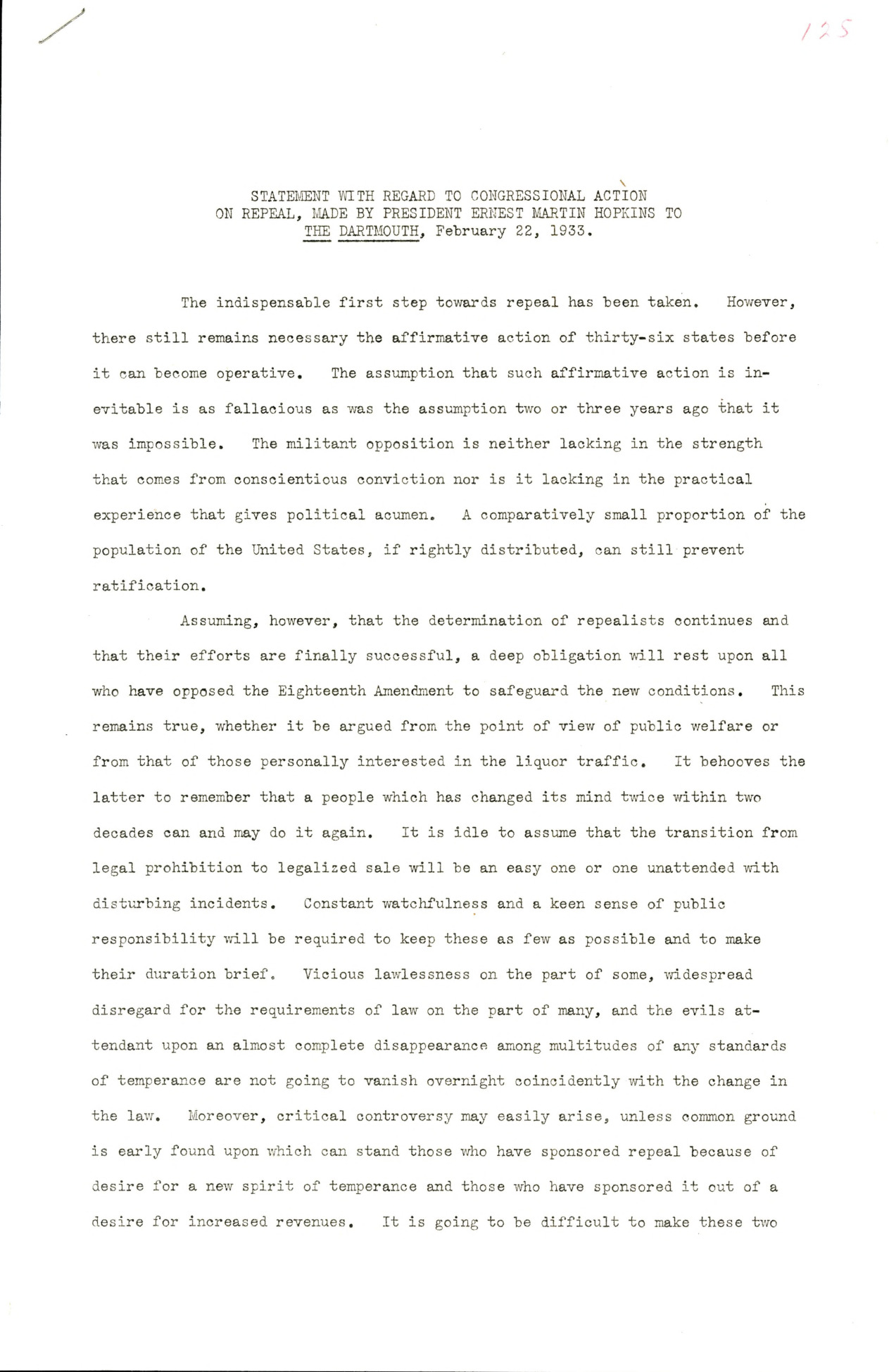
A lengthy statement from Hopkins to The Dartmouth on the repeal of the 18th Amendement in Congress.